8 -
1
2
3
4
5
6
7
8
9
10
11
12
13
14
15
16
17
18
19
20
Parts catalogue
Caution
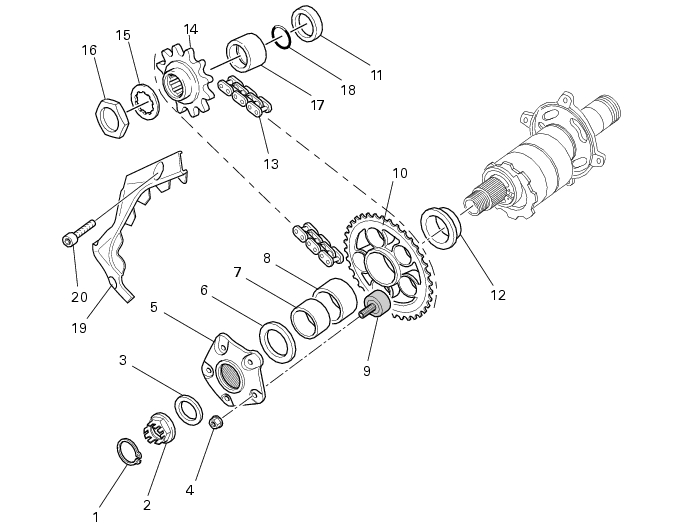
Bold reference numbers in this section identify parts shown in this exploded view diagram. These parts do not appear in the figures near the text.
Final drive inspection
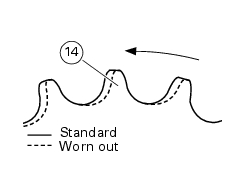
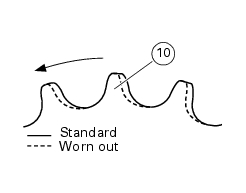
Check the wear of the final drive. Visually inspect the front (14) and rear (10) chain sprockets. If the tooth profile is as shown by the broken line in the figure, change the sprockets.
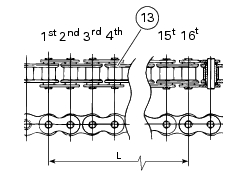
To check chain wear, stretch the chain (13) and measure 16 links.
If the length (L) is greater than 256.5 mm, change the chain.
Caution
When changing the rear chain sprocket (10), replace the front sprocket (14) and the chain (13) as well.
Removing the chain front sprocket
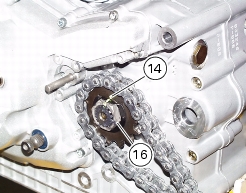
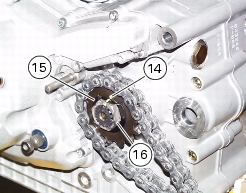
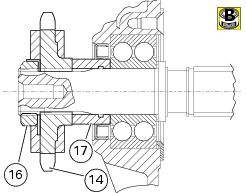
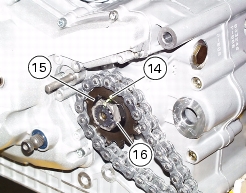
Final drive sprocket (14) is fastened by means of a nut (16) located on secondary shaft threaded end.
This solution locks the sprocket against inner ring of double ball bearing, thus enhancing assembly efficiency.
Remove the complete left footpeg, as described in Sect. H 4, Removing the footpegs.
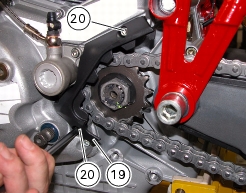
Unscrew the screws (20) and remove the sprocket cover (19).
Unbend the safety washer (15) and release the nut (16).
Engage a low gear and loosen nut (16) retaining chain front sprocket (14).
Slacken the chain (Sect. D 4, Adjusting chain tension).
Slide the chain off the rear sprocket.
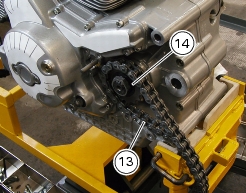
Remove the front sprocket (14) together with chain (13) from gearbox secondary shaft and change the final drive components.
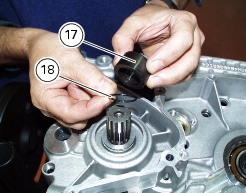
Before installation, ensure that the spacer (17) is in place on the secondary shaft.
Check that the splines of secondary shaft and sprocket are in perfect condition.
Install front sprocket (14) with chain, setting it with hub projection toward the engine.
Smear nut (16) with recommended grease and tighten it to the specified torque (Sect. C 3, Frame torque settings).
Bend the safety washer (15) on nut.
Caution
After wrapping the chain onto rear sprocket, tension it as described in Sect. D 4, Adjusting chain tension.
Replacing the gearbox secondary shaft seal
Note
The engine is shown removed from the frame for better clarity. This operation does not require engine removal.
 
Remove the front chain sprocket as described above. Slide the spacer (17) with the O-ring (18) off the shaft.
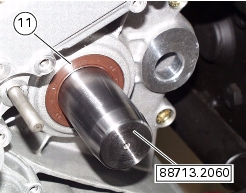
Prise the seal (11) out of the engine casing with the tip of a screwdriver.
Caution
The seal and O-ring should always be changed any time parts are removed.
 
Grease the O-ring (18) and fit it to the spacer (17) of the front chain sprocket.
Fit the spacer onto the secondary shaft and push it into contact with the bearing inner ring. The spacer face with the O-ring must be facing the bearing.
Install bushing of tool part no. 88713.2060 onto secondary shaft, lubricate and fit a new seal (11).
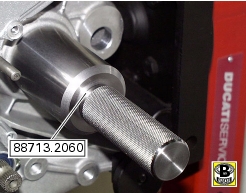
Use the tool drift to push the seal into firm contact with the bearing in the engine casing.
Refit the front chain sprocket as described in the previous paragraph.
Removing the rear sprocket
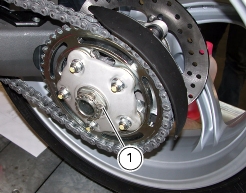
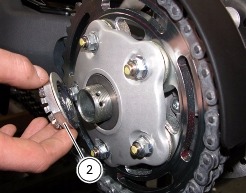
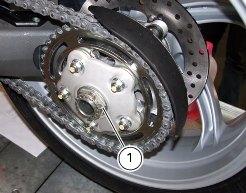
Remove the safety clip (1) of the nut (2).
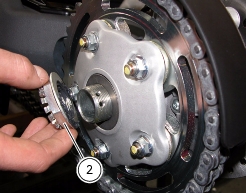
Lock out wheel shaft rotation and loosen the lock nut (2) with a socket wrench.
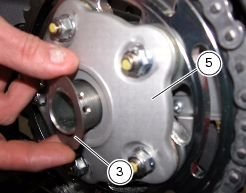
Undo the nut (2) fully and remove the washer (3) and the flange (5) together with the rear sprocket.
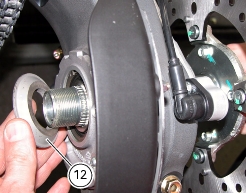
Collect the spacer with a collar (12).
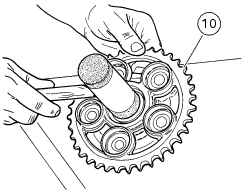
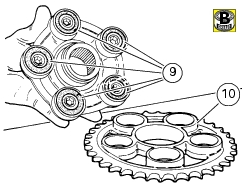
Tap the flange (5) with cush drive damper (9) with a mallet to push it out of the rear sprocket (10).
Check the cush drive damper bushes (9); remove them from the flange and replace them if needed.
Refit following the removal procedure in the reverse order and grease all mating surfaces and the under head of the nuts (4) retaining the cush drive damper bushes (9) with the recommended grease.
Check for wear as described at the beginning of this section.
To refit the nut (2) and clip (1) securing the rear sprocket plate, see the specifications given for the wheel lock nut in Sect. G 4, Refitting the rear wheel.
 
Washing the chain
Chains with O-rings must be washed in petrol, diesel fuel or paraffin oil.
Do not use fuel, trichloroethylene or other solvents which will damage the rubber O-rings. Use only sprays which specify that they are for use with O-ring chains.
Chain lubrication
O-ring chains have sealed, life-lubed link studs and bushes. However, these chains need lubricating at regular intervals to protect the metal parts and to keep the O-rings soft and pliable for guaranteed sealing.
Using a brush, apply a thin protective film of high-density engine oil along the entire length of the chain both inside and outside (see specifications in Sect. C 2, Fuels and lubricants).