4.3 -
1
2
3
4
5
6
7
8
9
10
11
12
13
14
15
16
17
18
19
20
21
22
23
24
25
26
27
28
29
30
31
32
Parts catalogue
Caution
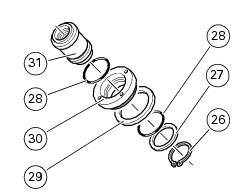
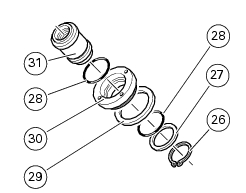
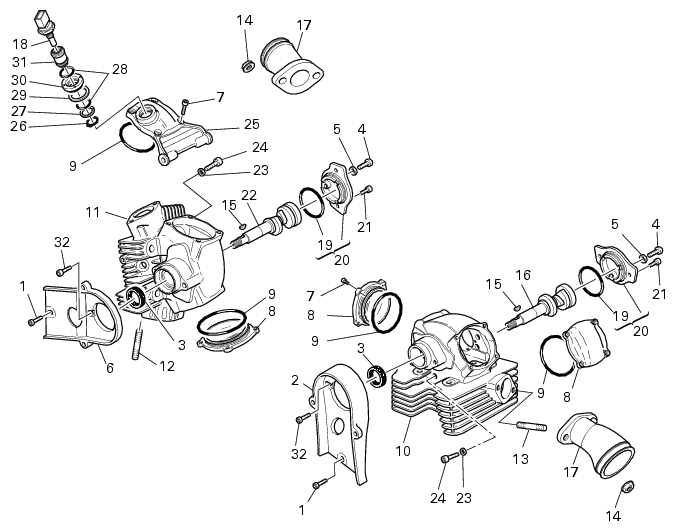
Bold reference numbers in this section identify parts shown in this exploded view diagram. These parts do not appear in the figures near the text.
Removing the engine oil temperature sensor
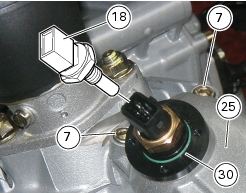
The engine oil temperature sensor (18) is placed on the intake valve cover (25) of the horizontal head (11).
Take the sensor (18) off its mount (31).
Unscrew the ring nut (30) from the cover (25).
Remove the circlip (26) from the ring nut and withdraw the sensor mount (31).
Refitting the engine oil temperature sensor
Check seal (29) and spacer (27). Replace as required.
Note
Change the O-rings (28) before refitting.
Installation is a reversal of the removal procedure.
Disassembling the intake manifolds
Note
This operation can be carried out even if engine is on the frame. For precision purposes, the figures show the head removed from the engine.
 
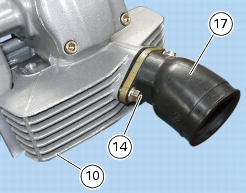
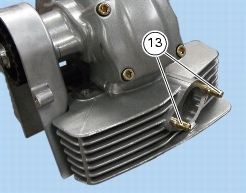
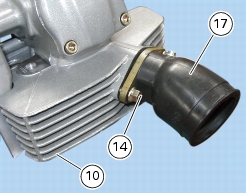
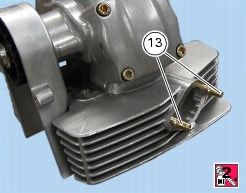
Undo and remove the lock nuts (14) of the vertical and horizontal head intake manifolds from the stud bolts (13).
Remove the manifolds (17).
Unscrew the stud bolts (12) and (13) from the heads, if needed.
Refitting the intake manifolds
Smear some recommended threadlocker on stud bolts (12) and (13), install them to heads (10) and (11) and tighten to the specified torque (Sect . C 3, Engine torque settings).
Position the intake manifolds (17) and secure them with the nuts (14).
Tighten the nuts (14) to the specified torque (Sect. C 3, Engine torque settings).
Removing the cam covers
Note
For clarity purposes, the figures show the head removed from the engine block.
 
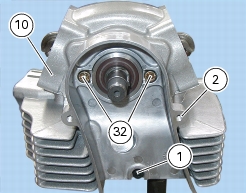
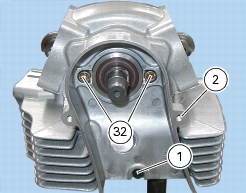
Unscrew the retaining screws (32) and (1) and remove the cap (2) from the vertical head (10).
Repeat procedure for the horizontal head (11).
Note
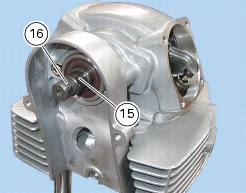
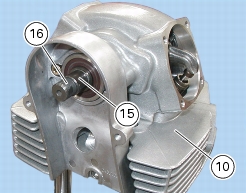
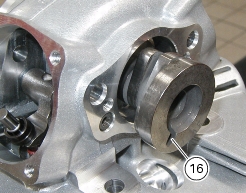
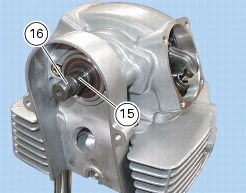
Be careful not to displace the keys (15) in the camshafts (16) and (22) when removing the cam covers
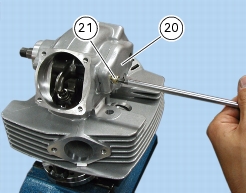
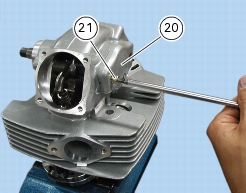
Unscrew the retaining screws (21) of the cover (20) supporting camshaft (16).
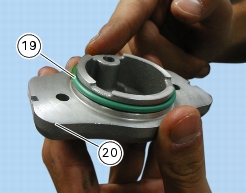
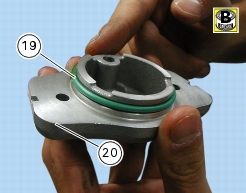
Remove the camshaft cap (20) from the head; keep the O-rings (19).
Now camshaft does not turn over ball bearings but onto hydrodynamic bearings, thus limiting the number of moving parts and helping heat dissipation.
Removing the valve covers
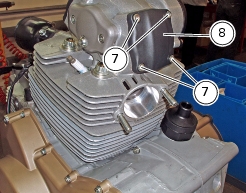
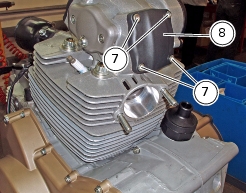
Unscrew the retaining screws (7) and remove the valve covers (8) and (25) with the O-ring (9).
Refitting the valve covers
Change the O-ring (9) at each reassembly.
Position the valve covers (8) and (25) with the O-ring (9) to the head.
Tighten the screws (7) to the specified torque (Sect. C 3, Engine torque settings).
 
Camshafts disassembly
 
Note
This operation is also possible with rocker arms fitted onto cylinder head. For your convenience, the pictures show a cylinder head with removed rocker arms.
 
Remove the cam covers as described above.
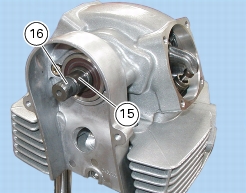
Remove the key (15) from the camshaft.
Note
Rotate the camshaft (16) until finding a position at which cams will not contact the rocker arms. This will avoid damage to the components during removal.
 
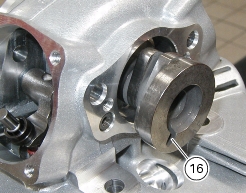
Extract the vertical head camshaft (16) from its seat.
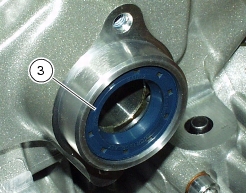
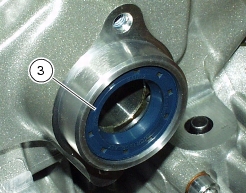
Remove the seal (3) from the head.
Checking the camshafts
Check that the contact surfaces of the cams are free from scratches, grooves, steps and waving. Worn cams prevent correct timing and lead to loss of performance.
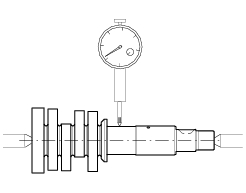
Insert the camshaft between two centres and check deviation using a dial gauge.
- Service limit:
0.1 mm.
Note
Actual deviation is half the gauge reading.
 
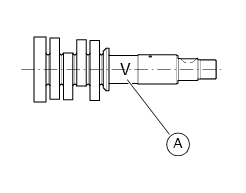
The camshaft is marked as follows:
O: horizontal
V: vertical
Checking the oil seals
Change oil seals at each engine overhaul.
Fit the new oil seals squarely into their grooves using suitable drifts.
Lubricate oil seal lip after installation. This operation requires the utmost care.
Refitting the camshaft
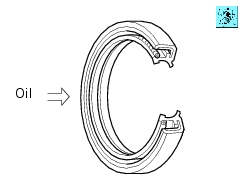
Renew the seal (3) at each reassembly. Fit seal into its seat on the right side of head (10) with the side without the spring positioned as shown in the figure.
Caution
If you have left the rocker arms in place in the head (Sect. N 4.4, Refitting the rocker arms), rotate the camshaft (16) until finding the position at which the cams will not contact the rocker arms.
Before installing the camshaft, check its marking (A): ā€œVā€ means vertical, while ā€œOā€ means horizontal.
Lubricate camshaft seats with graphitized oil to ensure lubrication during crankshaft running-in.
Insert the camshaft (16) from the left side of the head (10).
Check key (15) and keyway for wear and then fit it.
 
Refitting the cam covers
Lubricate the new O-rings (19) with the recommended grease and fit onto the cap (20).
Position the cam cover (20) to the left side of head.
Secure the cam cover (20) using the screws (21).
Tighten the screws (21) to the specified torque (Sect. C 3, Engine torque settings).
Note
Pay attention to the key (15) in the camshaft (16).
Position the horizontal head cam cover (2) to the left side of head and insert the retaining screws (1).
Ensure that the special screw (1) is correctly positioned.
Tighten the screws (32) and (1) to the specified torque (Sect. C 3, Engine torque settings).
Repeat procedure for the other head.
1