2.1 -
1
2
3
4
5
6
7
8
9
10
11
12
13
14
15
16
17
Spare parts catalogue
Caution
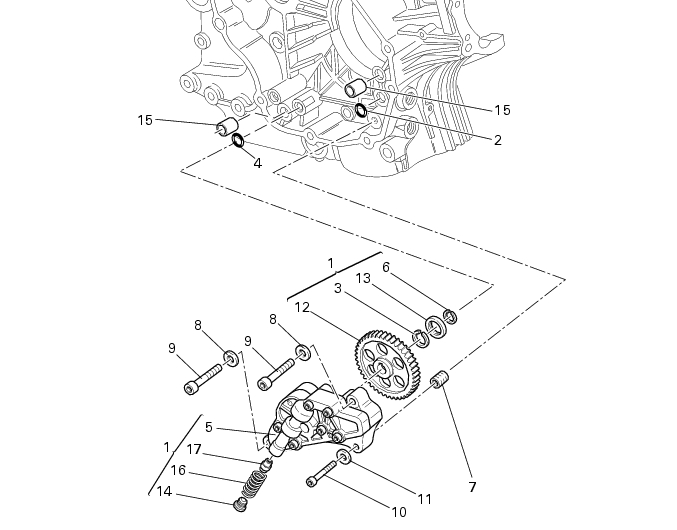
Bold reference numbers in this section identify parts shown in this exploded view diagram. These parts do not appear in the figures near the text.
Lubrication system
Description of the lubrication system
Forced lubrication by gear pump. Built-in pressure relief by-pass valve. Mesh intake filter. Disposable filter cartridge on intake with safety valve preventing cartridge clogging. Low oil pressure indicator on instrument panel.
 
Lubrication system components:
A
B
C
D
E
F
G
H
I
L
M
N
O
P
Q
Lubrication system operation
The oil gear pump (C) is driven by a toothed gear pair on the crankshaft. Pump flow rate therefore depends on engine speed (see reference values in Sect. D 5, Checking engine oil pressure).
The pump incorporates a pressure-reducing valve (B) delivering any excess oil caused by excessive pressure to the intake end.
Oil is pumped from the oil sump through a mesh filter (A) that holds back any coarse foreign matters - before oil reaches pump.
After flowing out of the pump, the oil flows into the cooler before reaching the cartridge filter (P), which is fitted with an inner anti-clogging valve ensuring proper oil circulation under all conditions. Please note that oil is not filtered if the valve opens.
After the filter, the oil flows to three different lubrication ways: two ways reach pistons as well as crankshaft bearings,
whereas the third one reaches the crankshaft (N) through an oil channel in the clutch cover (E).
As it flows into the crankshaft, oil lubricates con-rod big end bearings (D) and nozzles for piston crown cooling (L).
Then the oil also reaches the inner ring of the starter gear and the starter clutch (M).
Finally, coming out on the opposite end, the oil lubricates the crankshaft bearing in the generator cover.
The oil lubricates the camshafts through the oil delivery ways (F) to the heads (G).
Once flowing off the pressurised circuit and after lubricating the above parts, the oil lubricates primary transmission, gearbox and gearbox shaft bearings while falling back down into the engine block.
The breather circuit for vapours built into the engine block includes a reed breather valve at right casing top, a collection tank and a connection line.
Removing the oil pump
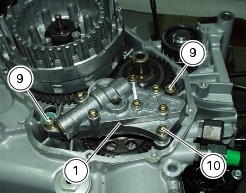
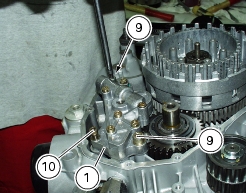
Undo and remove the screws (9) and (10) fixing the complete pump.
Remove the complete oil pump (1) and slide the two O-rings (2) and (4) and the two centring bushes (15) out of the casing.
 
Disassembling the oil pump gear
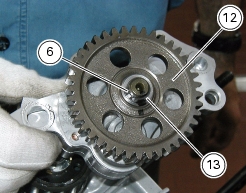
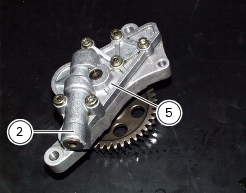
Vice the oil pump (1). Make sure not to damage the pump control gear (12).
 
Warning
Make sure that vice jaws are duly protected.
 
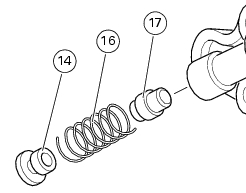
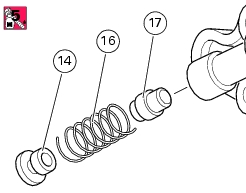
Remove plug (14) and slide out spring (16) and by-pass valve (17).
Check for proper operating conditions.
 
Remove the circlip (6), withdraw the bush (13) and remove the snap ring (3).
Remove the pump control gear (12).
 
Reassembling the oil pump gear
Insert pump driving gear (12), snap ring (3) and bushing (13) onto oil pump.
Fit the circlip (6) into its seat to lock the components in place.
Insert by-pass valve (17) and spring (16) into pump then tighten plug (14) to the specified torque (Sect. C 3, Engine torque settings) applying a medium-strength threadlocker.
Fit pump cover (2) to pump body (5) complete with gears.
Refitting the oil pump
Place the centring bushes (15) and the oil O-rings (2) and (4) at the oil ducts in the casing.
Place the oil pump on the casing and tighten the screws (9) and (10) to the specified torque (Sect. C 3, Engine torque settings).
Secure dial gauge part no. 88765.1058 provided with a special pointer on the casing to check the meshing clearance with the crankshaft sprocket.
Bring dial gauge pointer in contact with one of the oil pump gear teeth and set the instrument to zero on this position.
Slightly move the gear to measure the clearance. Take four readings in diametrically opposite positions of the gear.
Clearance must be 0.10 mm.