6.1 -
1
2
3
4
5
6
7
8
9
10
11
12
13
14
15
16
17
18
19
20
21
22
23
24
Parts catalogue
Caution
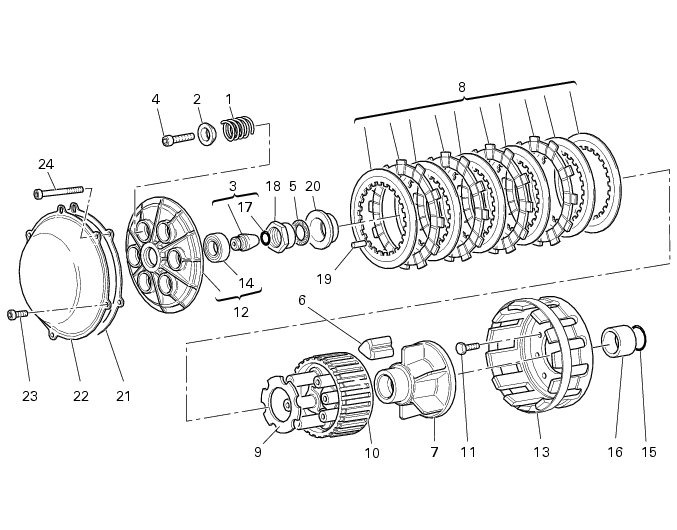
Bold reference numbers in this section identify parts shown in this exploded view diagram. These parts do not appear in the figures near the text.
Clutch unit
The clutch is disengaged by a drive unit consisting of a thrust piston (C) accommodated inside a small cap mounted to the generator cover. This piston (C) pushes a pushrod (B), which runs through gearbox primary shaft and operates the pressure plate (12) located on top of the clutch plate pack (8).
Motion is transmitted from the drum (10) to the gearbox primary shaft by special cush drive rubbers (6) which make clutch engagement smoother and avoid shocks on the drive parts involved.
Accommodated in the clutch housing is a set of drive and driven plates (9). When the clutch is operated, the driven plates push away a drum (12) which is splined onto the gearbox primary shaft.
Before operating on the internal clutch parts, check for proper operation. Then deal with the problem in a systematic manner.
The following is a list of possible causes of clutch malfunctioning.
 
A clutch which does not disengage may be caused by:
-
-
-
-
-
 
A clutch which slips may be caused by:
-
-
-
-
-
 
A noisy clutch may be caused by:
-
-
-
-
-
-
Disassembling the clutch
Note
For precision purposes, the figures show an engine removed from the frame.
 
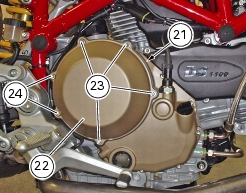
Undo the four (23) and the two (24) clutch inspection cover (22) retaining screws.
Remove the cover and the sound deadening gasket (21).
Unscrew the retaining screws (4) and remove the spring caps (2) and the clutch springs (1).
Pull out the pressure plate (12)
Using the suitable drift and a plastic mallet, remove clutch pushrod pin (3) and O-ring (17).
Then remove the bearing (14) from pressure plate (12) inner side with a drift having suitable diameter.
Note
Always replace the bearing if removed as described above.
Slide out the clutch plates (8).
Keep the plates in the same order as originally fitted. You may find it convenient to tie the plates together while putting them on the bench.
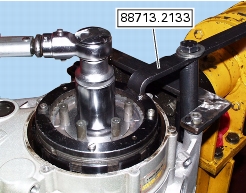
Secure the clutch drum (10) using service tool part no. 88713.2133 and remove the securing nut (18).
Remove safety washer (5), bushing (20) and thrust washer (9).
Pull out the drum (10) with cush drive rubbers from the clutch shaft.
If you need to change the cush drive rubbers (6), use a drift to knock cush drive rubber hub (7) out of clutch drum (10) and counteract the resistance provided by the cush drive rubbers.
Slide out spacer (16). Take care not to lose the inner O-ring (15).
 
Visually check the O-ring for proper conditions. Replace, if necessary.
Install tool part no. 88713.1805 to hold clutch housing steady while you loosen the screws (11).
Note
If no cover parts need to be serviced, leave the clutch housing assembly and the primary drive gear fitted into the clutch cover.
 
Undo the eight screws (11) securing the clutch housing to the primary drive gear.
Remove the clutch housing.
Checking and overhauling the components
Clearance between clutch housing and drive plate
Insert the drive plate (A) in the clutch housing (B) and measure clearance (S) with a feeler gauge.
The clearance "S" must not exceed 0.6 mm.
If it does, change the plates and, if necessary, the clutch housing.
Overhauling the clutch plates
The clutch plates must not show any signs of blackening, grooves or deformation.
Measure the thickness of the drive plates (friction plates). It should not be less than 2.6 mm.
Caution
Overall thickness of the set of clutch plates should not be less than 46.1 mm.
 
Place the plate on a flat surface and check the amount of deformation with a feeler gauge.
Max flatness error: 0.2 mm.
Overhauling the pressure plate
Check bearing condition. Change bearing if you find too much play.
Check surface that contacts the driven plate on top of the pack. Polish surface if heavily scored - see procedure specified for head contact surface.
Check the condition of the spring guides. Change the spring retainers at every overhaul.
Overhauling the pressure plate springs
Measure the length ā€œLā€ of the uncompressed springs (3):
Minimum length: 41 mm.
Change any springs which are shorter than that.
Reassembling the clutch
Fit clutch housing to primary drive gear.
Apply threadlocker onto the eight retaining screws (11) and fit them into the gear.
Caution
Use new retaining screws for the clutch housing.
 
Tighten the screws (11) to the specified torque working crossways (Section C 3, Engine torque settings).
Insert the spacer (16) with lubricated O-ring (15) on the primary shaft. The O-ring side should face the engine.
Fit clutch drum (10) with cush drive rubber on the primary shaft.
Fit the following on the primary shaft:
-
-
-
Secure clutch drum using service tool part no. 88713.2133 and tighten nut to the specified torque (Sect. C 3, Engine torque settings).
Insert the set of clutch plates (8) in the following order (see Figure):
-
-
-
one spring plate (L), thickness 1.5 mm, see position in cross-section;
-
Insert the control pin (3) in the pressure plate (12) bearing (14).
Fit the pressure plate (12) so that the mark etched at the end of one of the drum pins is lined up with the mark on the edge of the pressure plate hole.
Fit a spring (1) and cap (2) into each hole and fit the retaining screws (4) after lubricating their threads with engine oil.
Tighten the screws (4) working crossways and then tighten to the specified torque (Sect. C 3, Engine torque settings).
Position the gasket (21) and the clutch inspection cover (22) and then tighten the retaining screws (24) and (23) to the specified torque (Sect. C 3, Engine torque settings).
 
 
1