8 -
1
2
3
4
5
6
7
8
9
10
11
12
13
14
15
16
17
18
19
20
21
22
23
24
25
26
27
28
29
30
31
32
33
34
35
36
37
Parts catalogue
Caution
Bold reference numbers in this section identify parts shown in this exploded view diagram. These parts do not appear in the figures near the text.
 
Removing the generator cover
Note
For reasons of clarity, the figures show an engine removed from the frame.
 
Unscrew the screws (16) and remove the chain guard (2).
Undo the two retaining screws (6) of the small cover (5) placed at crankshaft end.
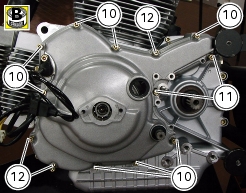
Undo the generator cover retaining screws (6), (11) and (12) (arrowed in the figure).
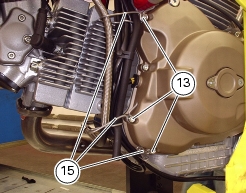
Keep both washers (14) and the tube guide (15).
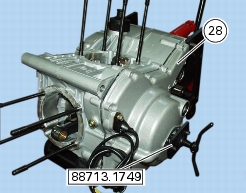
Fix tool part no. 88713.1749 to the holes of the screws (6) you have just removed.
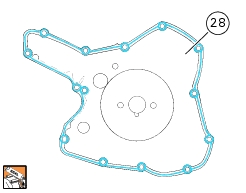
Turn the tool shaft slowly to remove the cover (28) from the LH casing.
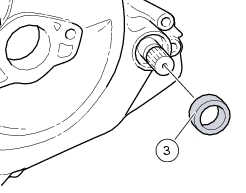
The cover has a seal (3) at the gear change lever shaft location. This seal could be easily damaged during removal of the generator cover.
Always check the seal for damage. Replace, if necessary.
Disassembling the generator cover
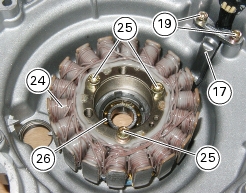
Undo the three stator retaining screws (25) and the two cable guide bracket (17) retaining screws (19) from inside the generator cover.
Remove stator (24) and cable guide (17).
Inside generator cover, at the crankshaft, there is a bearing (21) held in place by a circlip (20).
Remove circlip (20) with suitable tweezers.
Remove bearing (21) using a universal puller.
 
Removing the flywheel - generator assembly
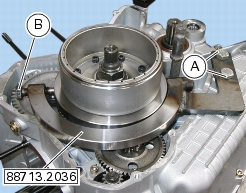
Fit tool part no. 88713.2036 and secure it to the M10 holes (A) (for the side stand fasteners) to prevent rotation.
Then lock tool on flywheel with the screw (B).
Use an “industrial heating gun” to heat the flywheel nut (36) before loosening it; it is recommended not to use bare flame that might damage the starting system components.
Warning
While unscrewing the nut, keep pressing box end axially onto nut to avoid damage or injury in the event wrench suddenly slips off the nut.
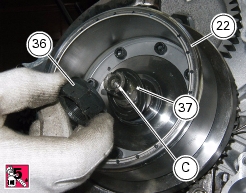
Remove nut (36), Belleville washer (37) and flywheel (22).
Remove driven gear (33) from crankshaft.
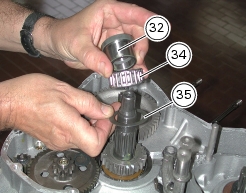
Remove inner ring (32), needle roller bearing (34) and washer (35).
Caution
Check inner ring (32), needle roller bearing (34) and inner washer (35) for wear.
Note
The inner ring (32) has an oil drilling for needle roller bearing (34) lubrication.
Checking the flywheel - generator assembly
Check that the generator rotor (23) inner part is not damaged.
Check that the starter clutch is working properly and that the needle races do not show signs of wear or damage of any kind.
In the event of defects, dismantle the assembly.
Disassembling the flywheel - generator assembly
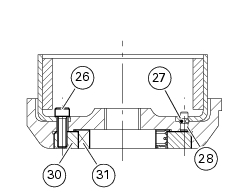
Undo the eight screws (26) and remove rotor (23) from flywheel.
Slide out reference pin (28) and circlip (27).
Start two of the screws (26), just removed from flywheel rotor-side, into their holes in order to remove flange (30) and starter clutch (31).
The starter clutch is a slight interference fit in the flange. To remove it, use a suitable drift.
 
Reassembling the flywheel - generator assembly
Locate starter clutch (31) to flange (30) with the larger diameter side (+) facing the flange. The flange should have the rounded side facing the starter clutch.
When refitting the starter clutch, make sure the arrow etched on outer ring is pointing in the direction of rotation of the engine.
Check that starter clutch is installed correctly as follows. Remember that the flywheel is fitted to the crankshaft spline and will turn with the crankshaft.
Turn the crankshaft counter clockwise. The flywheel will turn with the crankshaft, whereas starter motor and idle gear will not move (same as when the engine is running).
Turn the crankshaft clockwise; flywheel, starter motor and idle gear will turn as well.
Caution
When refitting the parts of the starter clutch, use engine oil only. Do not use grease as it could affect starter clutch operation.
 
Fit the flange (30) to the flywheel (16) with the tapered side facing the flywheel.
Install the flange with the aid of a pin or spanner fitted into the hole for the rotor flywheel reference pin (28) so to line up the flange threads with the flywheel holes. Since the flange is an interference fit, alignment must be done during - not after - installation.
Position reference pin (28) with circlip (27) into flywheel.
Apply threadlocker on the threads of screws (26) and fix rotor (23), flange (30) and starter clutch (31) to flywheel (29).
Tighten screws to the specified torque (Sect. C 3, Engine torque settings).
Refitting flywheel / generator assembly
Fit washer (35), roller bearing (34) and inner ring (32) on crankshaft. Make sure that inner ring becomes seated properly in the center of the washer.
Fit starter driven gear (33) on flywheel starter clutch.
Fit the thus-assembled flywheel unit (22) on the starter clutch (31). Make sure the inner ring (32) is still centered in the washer (35).
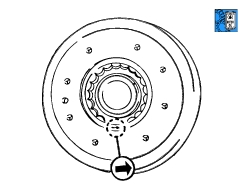
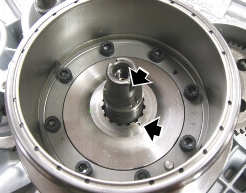
Flywheel reference mark must be aligned with the crankshaft spline, at the keyway.
Lubricate mating surfaces of Belleville washer (37) with engine oil.
Fit Belleville washer (37) onto crankshaft end.
Caution
Belleville washer (37) larger side shall be facing the flywheel.
 
Lock out flywheel rotation using the relevant tool part no. 88713.2036.
Remove any Loctite residue from nut (36) and crankshaft (C) thread.
In order to ensure correct coupling, sealant should be applied in 3 stripes along the crankshaft thread (C) and one stripe inside the nut (34).
Fit nut (36) onto shaft end (C): nut (36) larger side shall be facing the flywheel.
Caution
Nut (36) is to be tightened immediately after sealant is applied; tighten to the specified torque (Sect. C 3, Engine torque settings).
Warning
It is also recommended to allow three hours before starting the engine to ensure the sealant is completely dry.
 
Reassembling generator cover
Position stator (24) into the cover with the hole for the outgoing wire facing the cover and pointing towards the cover recess.
Apply threadlocker to the retaining screws (25) of the stator and tighten the screws to the specified torque (Sect. C 3, Engine torque settings).
Place the guide plate (17) over the wire and secure it to cover with the two screws (19).
Before installation, make sure that the crankshaft bearing (21) and its circlip are in place in the generator cover (28).
Clean off any deposits and degrease the mating surfaces of the LH-side casing and the generator cover.
Fit the two reference bushes (18).
Apply an even bead of DUCATI liquid gasket on the cover surface (28), avoiding the holes for the retaining screws and the centring bushes.
Grease the end of the crankshaft and of the gear change lever shaft. This will facilitate cover installation and prevent damage to the oil seal (3) if it is already installed in the cover.
Tap at different positions with a rubber mallet to help locate cover to shafts and centring bushes.
Note
In the event you need to remove the cover again, fit puller part no. 88713.1749 to the threaded holes at the crankshaft.
 
Start the retaining screws into their holes as indicated in the table.
Tighten the retaining screws to the specified torque (Sect. C 3, Engine torque settings).
Fit the washer (14) and the tube guide (15) under the screw (12), close to the starter motor.
Tighten the retaining screws to the specified torque (Sect. C 3, Engine torque settings).
Dampen oil seal (3) with alcohol and fit it on the generator cover, at the gear change lever shaft.
Apply grease to the screws (6).
Tighten the two screws (6), securing cover (5) at the crankshaft, to the specified torque (Sect. C 3, Engine torque settings).
Start the screws (16) in their thread and refit the chain guard (2).
 
1