2 -
1
2
3
4
5
6
7
8
9
10
11
12
13
14
15
16
17
18
Spare parts catalogue
Caution
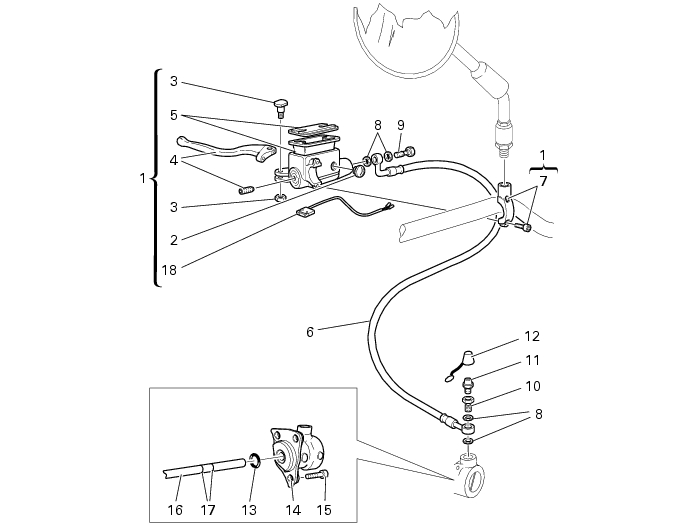
Bold reference numbers in this section identify parts shown in this exploded view diagram. These parts do not appear in the figures near the text.
Removing the clutch master cylinder assembly
Warning
Critical safety components. The clutch master cylinder manufacturer recommends that you do not attempt to service the internal components of the clutch master cylinder (1). Incorrect overhaul of these critical safety components can endanger rider safety.
 
Only a limited number of master cylinder parts should be replaced, that is control lever, reservoir assembly and cylinder fasteners.
 
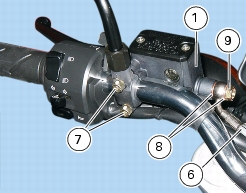
Undo the special screw (9) -keep the seals (8)- to release the clutch cylinder assembly (1) from the clutch control hose (6).
Unscrew the two screws (7) securing the master cylinder to the handlebar.
Remove the complete clutch cylinder assembly (1): please refer to exploded view diagram at the beginning of this section for clutch cylinder disassembly.
Refitting the clutch master cylinder assembly
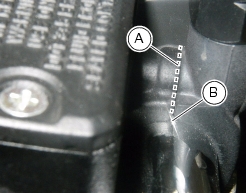
Fit the clutch master cylinder assembly (1). Line up the clamp / master cylinder body jointing line (A) with the dot (B) on the handlebar.
Tighten the retaining screws (7) to the specified torque (Sect. C 3, Frame torque settings) working in a 1-2-1 sequence.
Position the pipe (6) onto the clutch cylinder assembly (1) with a seal (8) and secure with special screw (9). Do not tighten it yet.
Warning
Incorrectly positioned hoses can cause faults and interfere with moving parts.
 
Refer to the figures at the end of these section for the correct routing of the clutch hose (6) and hose ties.
Position the hose (6) as shown in the figure and then tighten the special screw (9) to the specified torque (Sect. C 3, Frame torque settings).
 
Removing the clutch transmission unit
Warning
Critical safety components. The clutch transmission unit manufacturer recommends that you do not attempt to service the internal components of the clutch transmission unit (14).
Incorrect overhaul of these critical safety components can endanger rider and passenger safety.
Only a limited number of transmission unit parts should be replaced, that is bleed unit, seal and complete piston.
 
Unscrew the 3 screws (15) fixing the clutch transmission unit (14) to the engine.
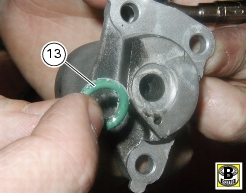
Withdraw the unit from the casing. Be careful of the O-ring (13) placed inside.
Remove the dust seal (12) and the bleed unit (11), loosen the screw (10) and then collect the seals (8): the unit (14) is now released from hose (6).
Push in the piston to expel all fluid inside the unit.
The clutch pushrod (16) can now be removed. Check the two O-rings (17) for wear and replace, if necessary.
Refitting the clutch transmission assembly
Lubricate and refit the clutch pushrod (16) with both O-rings (17).
Lubricate the seal (13) and fit with the transmission unit (14) onto the casing.
Tighten the screws (15) to the specified torque (Sect. C 3, Frame torque settings).
Position the hose (6) onto the clutch transmission unit (14). Ensure the hose fitting is properly positioned onto the unit (14).
Warning
Incorrectly positioned hoses can cause faults and interfere with moving parts.
 
Position both seals (8) and tighten the screw (10) to the specified torque (Sect. C 3, Frame torque settings).
Refit the drain (11) and the dust seal (12).
Please refer to the table on next page for proper positioning of clamps for hose (6).
 
Warning
Lubricate the O-ring (13) and the pushrod (16) before reassembly.
 
Clutch hose routing