4 -
1
2
3
4
5
6
7
8
9
10
11
12
13
14
15
16
Spare parts catalogue
Caution
Bold reference numbers in this section identify parts shown in this exploded view diagram. These parts do not appear in the figures near the text.
Removing the rear wheel
Place the motorcycle on a paddock stand so as to lift the rear wheel off the ground.
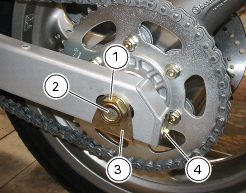
Undo the nut (1) on the right side of the swingarm.
Loosen the screws (4) so as to slacken the chain.
Loosen the screws (B) to remove the brake caliper (A) from the plate, but leave it connected to the system.
Withdraw the wheel shaft (2) together with the nut (1) from the left side. Collect the plates (3) at either side of the swingarm.
Caution
During this operation, properly support the wheel so that it will not fall while wheel shaft (2) is being removed.
 
Push the wheel forward to take the chain off the rear sprocket.
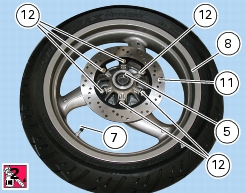
Remove the rear wheel from the motorcycle. The brake caliper mounting plate is sitting loose on the swingarm and the brake disc (11) might hit the plate during removal. Securing the plate to the swingarm with a tie might help prevent damage to the brake disc.
The removed wheel still holds the rear sprocket flange. Remove the screws (4), the cover (15) and the slider (16) in case slider (16) needs to be replaced.
Overhauling the rear wheel
Remove the rear sprocket flange from the wheel (Sect. G 8, Removing the rear sprocket). For bearing (5), bearing (10) and wheel shaft (2) inspection and for wheel rim (8) overhaul, please refer to "Overhauling the front wheel" in Sect. G 1.
Overhauling the rear brake disc
Release and remove the six screws (12) securing the brake disc (11) to the wheel shaft (2).
Remove the rear brake disc (11).
The brake disc must be perfectly clean, with no rust, oil, grease or other dirt and no deep scoring.
For brake disc service limit, please see (Sect. C 1.1, Hydraulic brakes).
Apply threadlocker to the screws (12).
Fit the brake disc (11), tighten the screws (12) to the specified torque (Sect. C 3, Frame torque settings).
It is possible to remove the vibration dampers (9) and replace them, if necessary.
Refitting the rear wheel
Fit the rear sprocket flange onto the wheel (Sect. G 8, Refitting the rear sprocket).
If the slider (16) has been removed, fit it into the swingarm together with the cover (15) and start the screws (4) in their holes. Fit the first plate (3) to the shaft (2). Grease the wheel shaft thread (2) and the contact surface of the nut (1). Snug the nut on the wheel shaft thread (2). Tighten the nut until one circle of the wheel shaft thread is visible at the opposite end.
Insert the wheel shaft from the left end of swingarm. Make sure to match the hole in the left chain slider.
Hold the caliper plate in position onto swingarm clip, fit the clip into plate slot.
Slide the wheel in the swingarm.
Insert the wheel shaft (2) from the left side of the swingarm through wheel hub, brake caliper plate hole and right chain slider hole and push the wheel shaft fully home.
Make sure the plate bent end (3) is at the bottom end of the swingarm.
Wrap the chain around the rear sprocket.
Fit the other plate (3) on swingarm right-hand side.
Grease the wheel shaft thread (2) and the contact surface of the nut (1) and screw nut onto shaft (2).
Tighten the nut finger-tight.
Tension the chain and align the wheel (Sect. D 4, Adjusting chain tension).
Make sure the brake hose does not become trapped or is exceedingly bent.
Tighten the nut (1) onto wheel shaft (2) to the specified torque (Sect. C 3, Frame torque settings).
Tighten the chain tensioner screws (4) to the specified torque (Sect. C 3, Frame torque settings).
Refit the brake caliper (A), tighten the screws (B) to the specified torque (Sect. C 3, Frame torque settings).
Note
The air gap between sensor (S) and brake disc retaining screw must be 0.6-2.2 mm.