8 -
The Immobilizer allows the vehicle to be started only if the rider uses the special ignition key which sends the identification code to a decoder fitted into the instrument panel. The emitting - receiving system is made of a TRANSPONDER fitted into the ignition key heads and an antenna close to the ignition lock.
Transponder keys
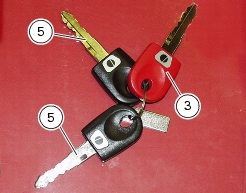
Immobilizer has different keys: a red key and two black keys.
One red key:
-
-
-
-
Two black keys:
-
-
Transponder is included into the key head and consists of a power supply circuit, a ROM (Read-Only Memory) and a transmission circuit. The Transponder is power supplied through the magnetic field generated by the antenna which is enabled as soon as the instrument panel is switched on. As it is very compact and needs no outer power supply through a battery, it is directly fitted into the key head.
Warning
Circuits into the key head are not shockproof.
Immobilizer antenna
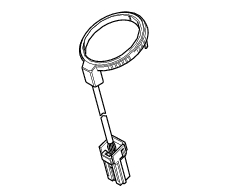
The antenna consists of a plastic-coated copper coil connected to wires ending up with a connector.
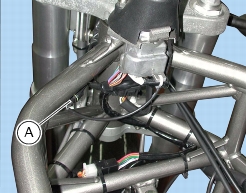
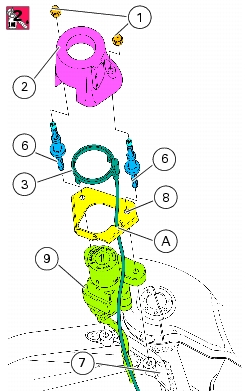
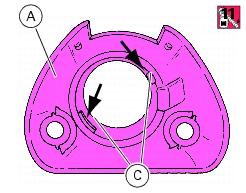
The antenna (A) is fitted onto the ignition lock into its specially designed seat.
Operating principle of the immobilizer
When the ignition key is positioned to ON, the decoder into the instrument panel energises the antenna, which generates an electromagnetic field power-supplying the key transponder. The Transponder sends the code stored into its ROM, which is received by the antenna and sent to the decoder. Here the secret code is matched with a second code. If matching is successful, then the decoder sends a code to the engine control unit (CCM) via special serial line (ISO 9141/5). The engine control unit checks received code and enables engine start if code is correct.
Immobilizer warning lights and indications
Each time the key is turned from ON to OFF, engine is disabled by the immobilizer.
When the ignition key is turned from OFF to ON, the system will signal the following:
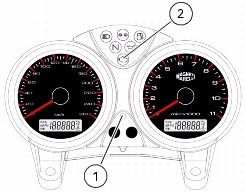
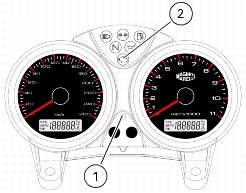
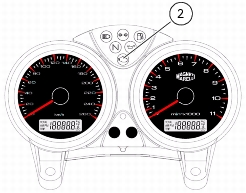
if code is acknowledged, the led (1) will turn on and then off;
if code is not acknowledged, the led (1) and the EOBD light (2) for ignition-injection failure will turn on and stay on. Engine will not start. Repeat the above procedure but using a different black key.
Caution
When programming the immobilizer as described below, use only the required key and keep the other keys away otherwise they might interfere.
Note
At least three keys (included the RED key) are necessary to program the immobilizer up to max. 8 keys (included the RED key).
Programming the immobilizer
If one or more parts of the immobilizer are replaced, such as black keys, decoder or engine control unit, system must be reprogrammed. Proceed as follows:
-
-
-
-
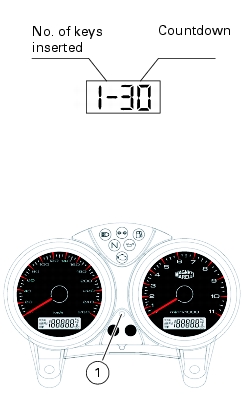
turn the key to ON so to switch on the instrument panel. The multifunction display will show the number of inserted keys (here "1") and a countdown starting from 30. Important: ensure that the ignition switch was to OFF for at least thirty seconds before performing the above
-
-
-
-
-
-
-
-
 
Now two black keys and the decoder inside the instrument panel are successfully programmed. Continue as follows:
 
-
-
-
 
Now the programming procedure is over. Immobilizer programming is completed. The above procedure must be fully complied with even though just a part of the immobilizer system needs to be programmed. Partial programming is not allowed! When finished, ensure that the engine starts if programmed black keys are used.
 
Warning
If "OFF" shows on the multifunction display when programming, it means that the programming procedure has been aborted. Repeat the procedure from the start. Strictly comply with given times and indication for correct immobilizer programming.
Checking for correct immobilizer programming
Insert the red key in the ignition switch. Set it to ON. The led (1) on the instrument panel will flash (see further below for details of LED indications). And then led (1) turns off.
First flashing indication:
-
if the led flashes for two seconds, it means that the immobilizer is not programmed, maybe because the programming procedure has not been strictly followed. Repeat the programming procedure from the start.
-
Second flashing indication:
-
Third flashing indication (possible immobilizer system faults):
-
-
-
-
-
If one of the above cases under "third flashing indication" occurs, the engine cannot be started.
Emergency procedure to override the immobilizer system
If the immobilizer is faulty, follow the emergency procedure below to start the engine.
1
2
3
Now enter the electronic code indicated on the CODE CARD which is given to the customer on motorcycle delivery by the dealer.
the EOBD light starts flashing.
count a number of EOBD light flashes which is as the first digit of the electronic code. Completely turn the throttle twistgrip and hold it open. The EOBD light stays fixed on for four seconds: it means that the first digit of the emergency code has been acknowledged.
If the throttle twistgrip is untouched, the EOBD light will flash 20 times, then it will stay permanently on. In this case the whole procedure should be repeated from step 1.
4
5
6
After releasing the throttle twistgrip and if the entered code is correct, the EOBD light will flash for 4 seconds to indicate that the immobilizer is now disabled. Then it turns off. It will immediately turn off if the engine is started before 4 seconds have elapsed.
7
Note
Each time the key is positioned to OFF after overriding the immobilizer as described above, upon the following key-ON the same error will show (and engine is disabled again). The above procedure should be repeated to override the immobilizer system again and enable engine starting.
The electronic code can be entered even via "DDS" as described in “Procedure to override the immobilizer system" (Sect. D 5).
Removing the immobilizer
Turn the ignition switch to OFF.
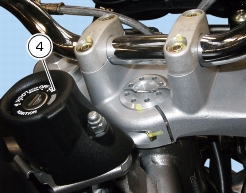
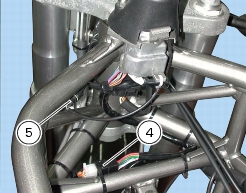
Disconnect the immobilizer antenna connector (5) at the bottom end of the switch assembly. Disconnect the switch connector (4).
Note
References (4) and (5) are the same as those of diagrams under “Arrangement of wiring on frame” of Sect. P 1.
Remove the immobilizer antenna wire ties.
Undo the two nuts (1) retaining the Immobilizer antenna guard.
Remove the cover (2) and lift the Immobilizer antenna (3) clear of the key-operated switch.
Remove the special screws (6).
Remove the key-operated switch (9) complete with plate (8) from the frame.
Separate plate (8) and key-operated switch (9).
Refitting the immobilizer
Thread the immobilizer antenna wire (3) through the plate (8).
Fit plate to key-operated switch (9). Thread the antenna wire through the plate slot (A).
Apply threadlocker to the two special screws (6).
Install the key-operated switch (with plate and antenna) to the frame (7) and start the two special screws (6) in their holes.
Turn the screws fully in and tighten to the specified torque (Sect. C 3, Frame torque settings).
Apply a drop of Loctite inside the cover (2) at the positions shown.
Locate antenna (3) to cover (2), and secure it in place with the two pegs (C) of the cover.
Fit the cover on the key-operated switch, easing the antenna wire downwards.
Start the two blind nuts (1) on their threads.
Tighten nuts to the specified torque (Sect. C 3, Frame torque settings).
Dismantling the red key with transponder
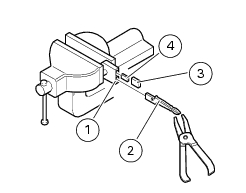
Vice the key grip (1). Make sure the vice jaws are protected.
Use pliers to extract the key (2), the protections (3) and the transponder (4).
Change any damaged components and reverse the dismantling procedure to reassemble.