7.2 -
1
2
3
4
5
6
7
8
Driving gear - 3rd- 4th speed.
9
10
11
12
13
14
15
16
17
18
19
20
21
22
23
24
25
26
27
28
Gear selector fork - 1st, 4th - 2nd, 3rd speed
29
30
31
32
33
34
Parts catalogue
Caution
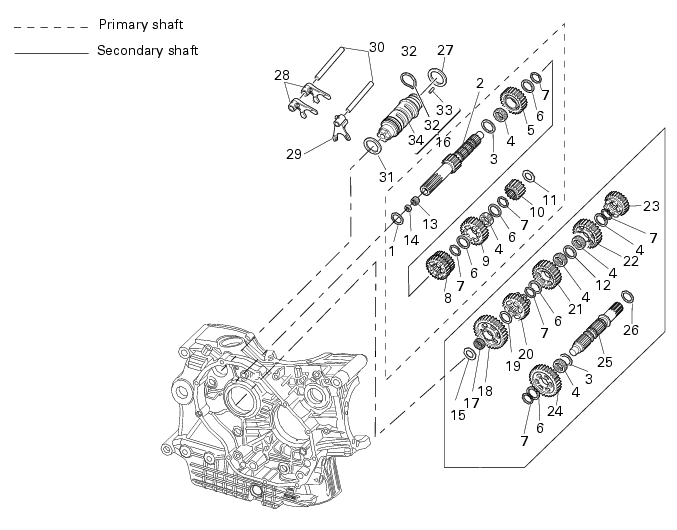
Bold reference numbers in this section identify parts shown in this exploded view diagram. These parts do not appear in the figures near the text.
Removing the gearbox
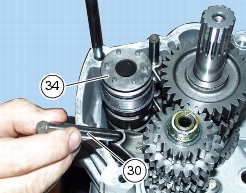
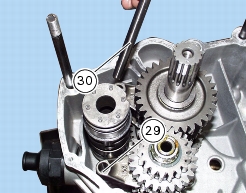
Pull out the fork guide pins (30).
Move the forks (28) and (29) to disengage them from the selector drum slots (34).
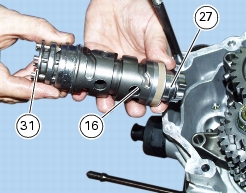
Pull out the fork selector drum (16). Pay attention to the shims (31) and (27) fitted on the shaft, make sure to refit them to their original position.
Now you can replace the needle roller stop ring (32) and the special needle rollers (33).
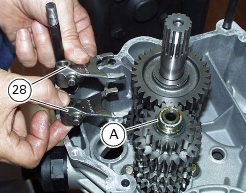
Remove the gear selector forks (29) and (28).
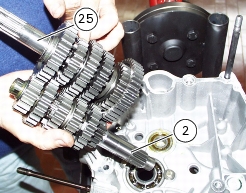
Remove gearbox primary (2) and secondary (25) shafts complete with gears. Do not damage or lose the shims at shaft ends.
If the bearing inner rings (A) remained on the shafts, slide them out of the gearbox primary (2) and secondary (25) shafts (Sect. N 9.2, Main bearings).
Disassembling the gearbox shafts
Put the shaft in a vice to make disassembly operations easier.
Caution
Refit the shims in the original positions on assembly.
Failure to do so could lead to jamming and you will have to re-open engine casing.
Disassembling the secondary shaft
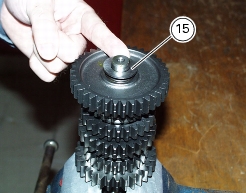
Remove the clutch-side shim (26) and the chain-side shim (15) from secondary shaft.
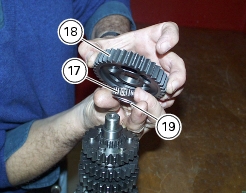
Slide out the first driven gear (18) with needle roller bearing (17) and shim (19).
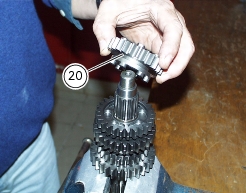
Slide out the fifth driven gear (20).
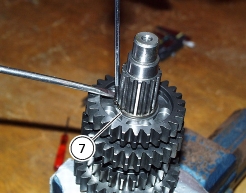
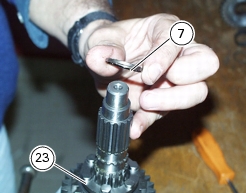
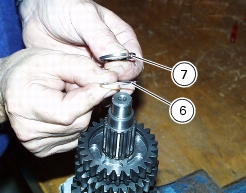
Using two flat screwdrivers, remove circlip (7) taking care not to damage the shaft surface.
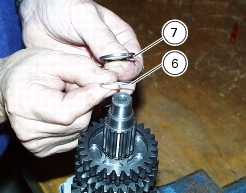
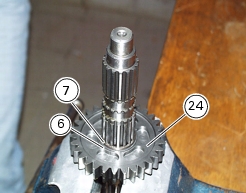
Slide out circlip (7) and safety washer (6).
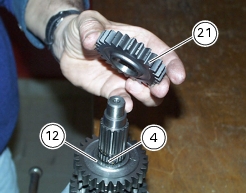
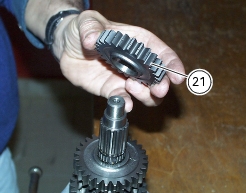
Remove the driven gear for the 4th speed (21), its needle roller cage (4) and the safety washer (12).
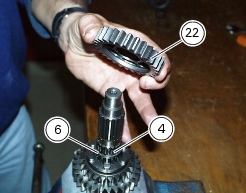
Remove the driven gear for the 3rd speed (22), its needle roller cage (4) and the safety washer (6).
Remove the circlip (7) and remove the driven gear for the 6th speed (23).
Remove the circlip (7), the safety washer (6) and the driven gear for the 2nd speed (24).
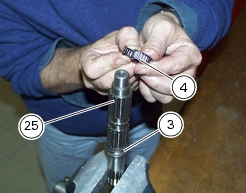
Pull out the roller cage (4) and the shim (3) so that the secondary shaft (25) is fully bare.
Disassembling the primary shaft
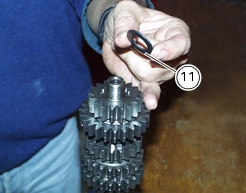
Remove chain-side shim (11) and clutch-side shim (1) from primary shaft.
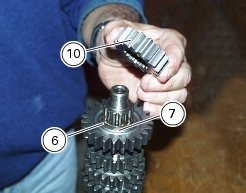
Slide out the 2nd drive gear (10). Using two screwdrivers, remove circlip (7) and safety washer (6).
Caution
When removing circlip (7), take care not to damage the shaft surface.
 
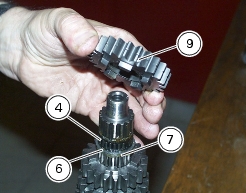
Slide out sixth drive gear (9) with needle roller bearing (4). Then slide out safety washer (6) and circlip (7).
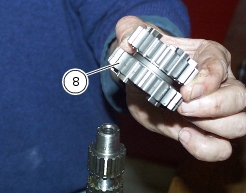
Slide out third and fourth drive gear (8).
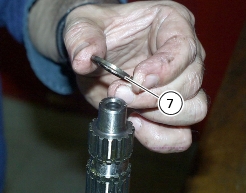
Slide out circlip (7) and safety washer (6).
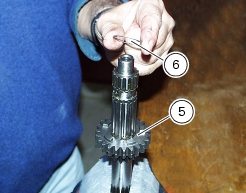
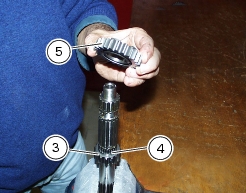
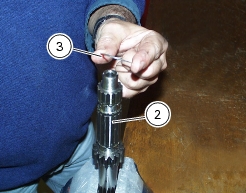
Slide out fifth drive gear (5) with needle roller bearing (4).
Slide out shim (3) from primary shaft.
 
Overhauling the gearbox
Check the condition of the gear front coupling dogs. They must not be damaged in any way and must have sharp edges.
The idle gears must rotate freely on their shafts.
When refitting, make sure the circlips are correctly positioned.
Check the needle roller bearings for wear.
The threading and the splines of the shafts must be in perfect condition.
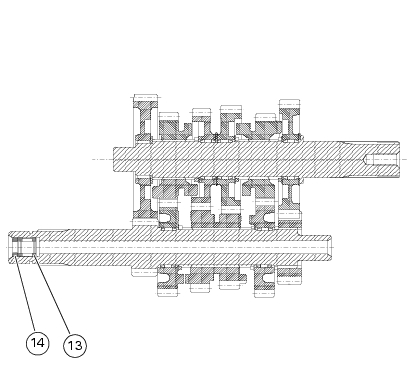
Check the condition of the needle roller cage (13) and of the oil seal (14) on top of the gearbox primary shaft. If needed, remove them with a suitable puller and replace.
Check the condition of the gear selection mechanism parts.
Engage the gears and check that the gearbox control does not jam (selector fork-gear groove and fork pin - desmodromic drum groove) due to incorrect end float. Correct clearances by shimming the gearbox shafts and drum with suitable shims.
 
For total end float of gearbox shafts and selector drums, refer to Sect. C 1.1, Gearbox.
 
Inspecting the gear selector forks
Visually inspect the gear selector forks. Bent forks must be changed as they may lead to difficulties in gear changing or may suddenly disengage under load.
Use a feeler gauge to check the clearance of each fork in its gear groove.
If it exceeds the service limit, establish whether it is necessary to change the gear or the fork by referring to the limits specified for each part (Sect. C 1.1, Gearbox).
 
Inspecting the fork selector drum
To establish the clearance between fork drive pin and selector drum slot, measure their dimensions with a gauge.
If the service limit is exceeded, establish which part must be changed, by comparing the values with the values of new components (Sect. C 1.1, Gearbox).
Also check wear on drum support pins; they must not show any signs of grooves, burrs and deformation.
Turn the drum in the casing to check the side play. If there is excessive play, change whichever part is most worn.
 
Reassembling the gearbox shafts
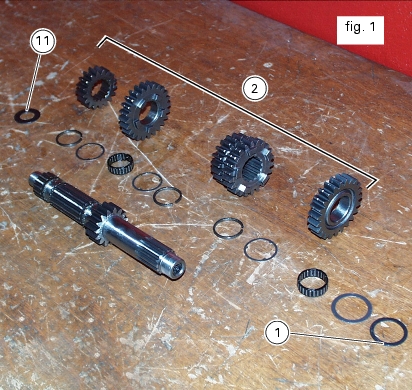
Fig. 1 shows all parts to be fitted onto the primary shaft (2), after calculating correct thickness for shims (1) and (11) (Sect. N 9.2, Shimming the shafts).
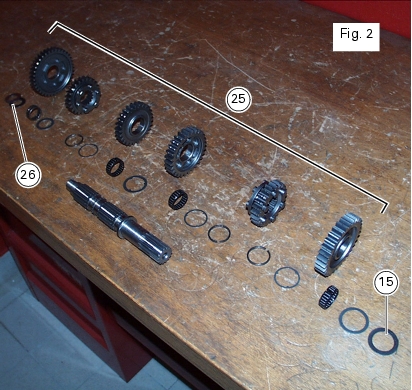
Fig. 2 shows all parts to be fitted onto the secondary shaft (25), after calculating correct thickness for shims (15) and (26) (Sect. N 9.2, Shimming the shafts).
Fit all gears onto gearbox shafts following the removal procedure in the reverse order.
Special care must be taken when fitting idle gears. Installation of 3rd and 4th gears and all fasteners onto the secondary shaft is here shown by way of example.
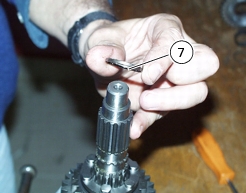
Fit the circlip (7). Ensure it is fully seated into the shaft. It is recommended a suitably sized tube drift be used to seat the ring.
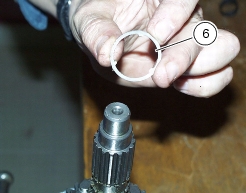
Fit the safety washer (6) into the shaft; it should rest against the circlip.
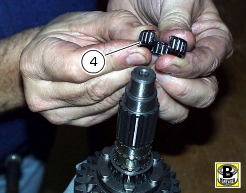
Grease the needle roller cage (4) richly with the recommended grease and seat it; open it a bit to fit onto the shaft.
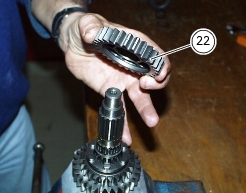
Fit the gear for 3rd speed (22).
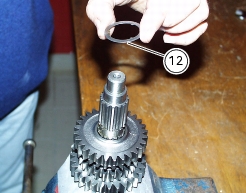
Fit the safety washer (12) onto the gear; it is larger than the other safety washer (6).
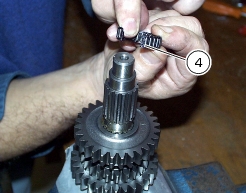
Fit another needle roller cage (4) as described.
Fit the gear for 4th speed (21).
Fit another safety washer (6) and another circlip (7) into the shaft. Seat it using the drift.
Reassembling the gearbox
To reassemble gearbox components, follow the procedure under Section
N 9.2 "Closing the casings" relating to the engine casings reassembly.
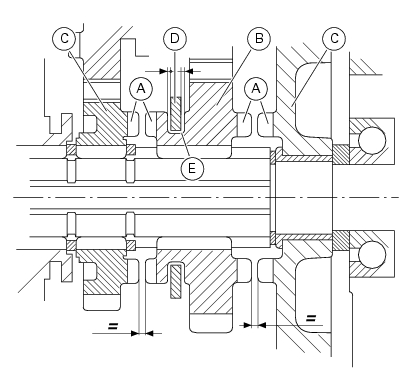
When finished, run a practical test. Place gear in neutral and check that the front coupling dogs (A) of the sliding gears (B) are centred to the matching dogs of the fixed gears (C), i.e. that the distance is the same at both ends.
Engage a gear and make also sure there is always a small clearance between fork (D) and matching groove (E) in the sliding gear (B).
 
1