9.1 -
1
2
3
4
5
6
7
8
9
10
11
12
13
14
15
16
17
18
19
20
21
22
23
24
25
26
27
28
29
30
31
Parts catalogue
Caution
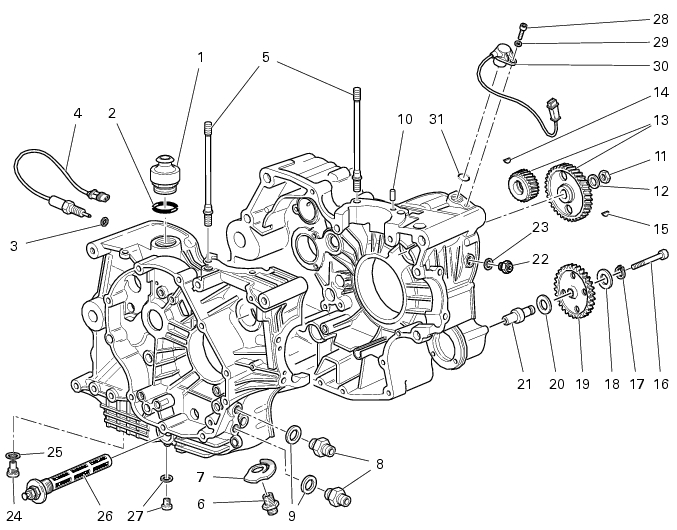
Bold reference numbers in this section identify parts shown in this exploded view diagram. These parts do not appear in the figures near the text.
Removing outer components
Note
The removal procedure described is only necessary when changing or cleaning the casings. If the original casings are reused, the components may be left in place.
 
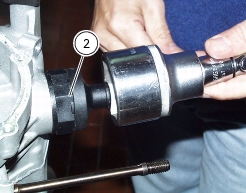
Remove oil breather valve (1) and O-ring (2) from the engine block.
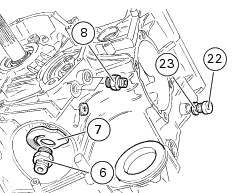
Unscrew and remove the two nipples (8) for oil inlet and outlet from the clutch-side casing and remove their seals (9).
Undo and remove the oil cartridge filter (Sect. D 4, Changing the engine oil and filter cartridge).
Undo and remove the oil filter nipple (6) and the by-pass spring (7).
Undo and remove the screw (22) with gasket (23) to check engine timing sensor air gap.
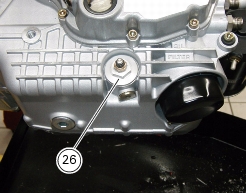
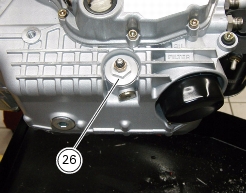
Remove mesh filter (26) and seal from the clutch-side casing as described under Sect. D 4, Changing the engine oil and filter cartridge.
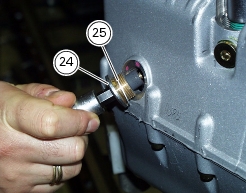
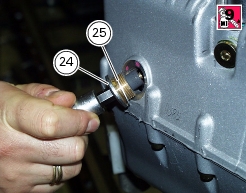
Remove drain plug (24) with seal (25).
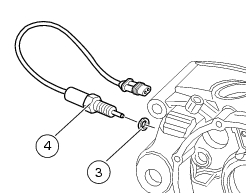
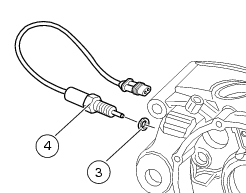
Remove neutral light switch (4) with seal (3).
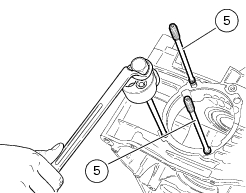
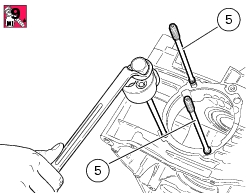
Using the special tool, remove head stud bolts (5).
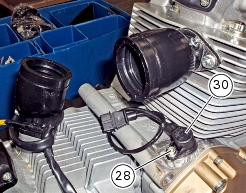
Unscrew the retaining screw (28) of the engine sensor (30) and collect the washer (29).
Check the O-ring (31) for wear. Change, if necessary.
If the engine sensor is changed, it is necessary to check the sensor air gap as specified under “Checking the engine sensor air gap”.
Reassembling the outer components
Grease and start the engine sensor (30) in its seat on crankcase.
Fit washer (29) and tighten the screw (28) to the specified torque (Sect. C 3, Engine torque settings).
Use a feeler gauge to measure air gap between engine sensor (30) and timing gear (13). Correct air gap is between 0.6 and 0.8 mm.
Note
If the air gap is incorrect, loosen engine sensor retaining screw (28) and change shim (24) with a more suitable one (paragraph “Checking the engine sensor air gap”).
Check O-ring (2) for wear. Change, if necessary.
Fit oil breather valve (1) with O-ring (2) inside engine and tighten to the specified torque (Sect. C 3, Engine torque settings).
Tighten the two nipples (8) with oil tube seals (9) to the specified torque (Sect. C 3, Engine torque settings).
Position the by-pass spring (7) and tighten the nipple (6) supporting oil filter cartridge to the specified torque (Sect. C 3, Engine torque settings).
Tighten the drain plug (24) with seal (25) to the specified torque (Sect. C 3, Engine torque settings) after applying the recommended threadlocker.
Refit the neutral switch (4) with seal (3) and tighten to the specified torque (Sect. C 3, Engine torque settings).
Refit mesh filter (26) with seal, as described in Sect. D 4, Changing the engine oil and filter cartridge.
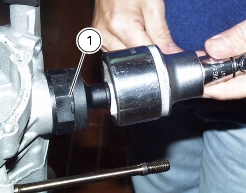
To refit stud bolts (5) on casing, apply speed bond on threads and tighten to the specified torque (Sect. C 3, Engine torque settings). Use the special tool for this operation.
 
Removing the timing lay gear
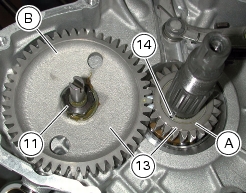
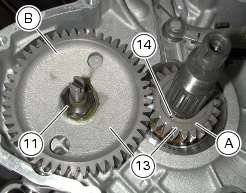
Remove the drive gear (A) of timing lay gears (13) and the key (14) from crankshaft.
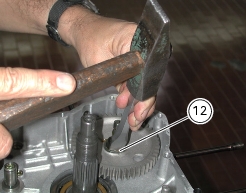
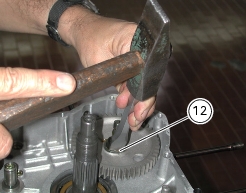
Straighten nut (11) safety washer (12).
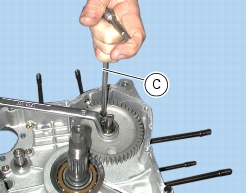
To lock driven timing gear (B), install a pin (C) inside one of the holes and loosen locking nut (11).
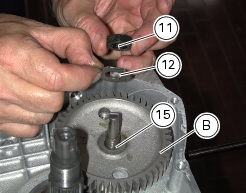
Take out nut (11), washer (12), timing driven gear (B) and key (15) from timing layshaft.
Reassembling the timing lay gear
Before reassembling the removed parts, check timing gears (13) for wear. Change, if necessary.
Caution
The two timing gears (13) must be always changed in pair.
 
To reassemble, follow the disassembly procedure in reverse order.
Caution
Once finished, make sure that washer (12) is bent on nut (11) to prevent it from getting loose.
 
Removing the starter motor driven gear
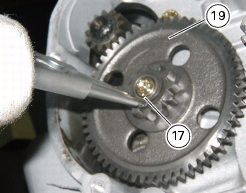
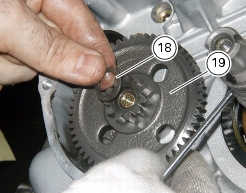
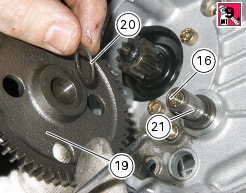
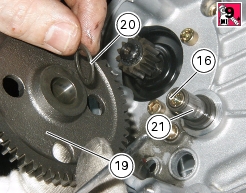
Remove snap ring (17) and washer (18).
Take out starter driven gear (19) and shim (20).
Loosen screw (16) on lay shaft (21) and remove shaft.
You may now remove the starter motor as described in Sect. P 3, Removing the starter motor.
Reassembling the starter motor driven gear
Fit all parts following the removal procedure in the reverse order.
Apply recommended threadlocker to screw (16), then tighten it to the specified torque (Sect. C 3, Engine torque settings).
 
Checking the engine sensor air gap
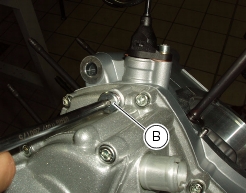
Remove screw plug (B) from the inspection hole in the generator cover.
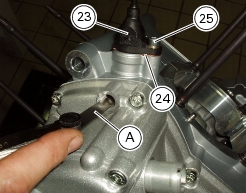
Fit a feeler gauge (A) into the hole and measure the air gap between the sensor (23) and the timing lay gear teeth.
Check that air gap is 0.6-0.8 mm.
If this is not the case, loosen sensor (23) screw (25) in order to slide out shim (24) and to change it with one having a suitable thickness.
Note
As shown in the figure, three shims with different colours are available.
Tighten the screw (25) to the specified torque (Sect. C 3, Engine torque settings).
Refit plug (B) with seal and tighten to the specified torque (Sect. C 3, Engine torque settings).
 
1