1 -
1
2
3
4
5
6
7
8
9
10
11
Parts catalogue
Caution
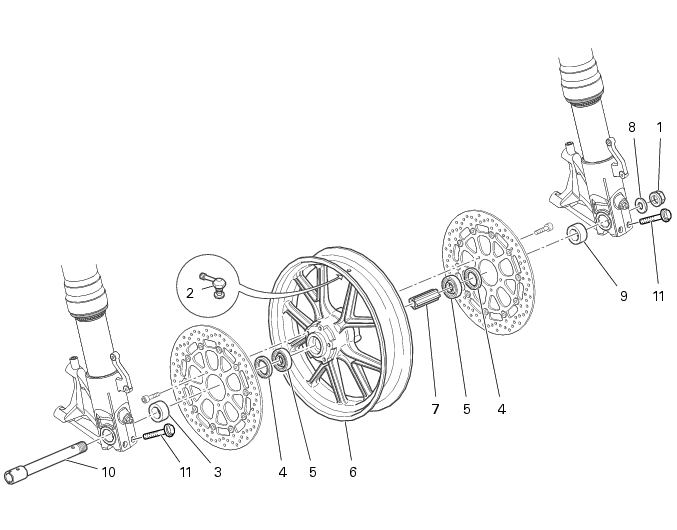
Bold reference numbers in this section identify parts shown in this exploded view diagram. These parts do not appear in the figures near the text.
Removing the front wheel
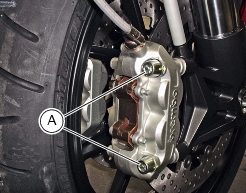
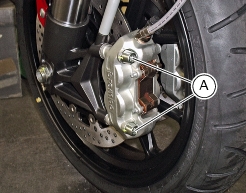
Loosen screws (A) and remove the front brake calipers together with hoses.
Warning
Do not operate the brake lever when the calipers are disassembled or fluid will leak out from the actuating pistons.
Support the bike adequately so that the wheel to be removed is raised from the ground.
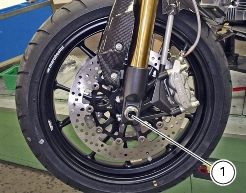
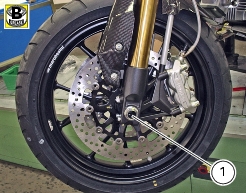
Undo and remove the nut (1) on the LH end of the wheel shaft.
Collect the washer (2).
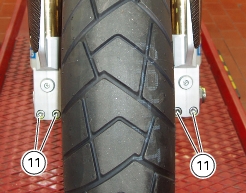
Loosen the wheel shaft pinch bolts (11) on the fork legs.
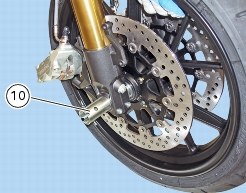
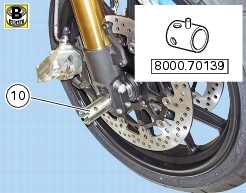
Working from the left side, knock the wheel shaft (10) out to the other side with a plastic hammer and then withdraw the shaft.
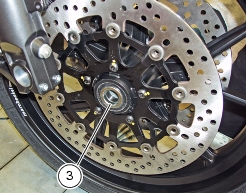
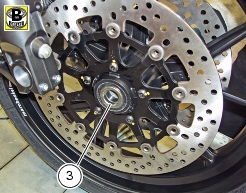
Remove the wheel and collect the spacers (3) and (9).
Overhauling the front wheel
Wheel bearings
Before checking dimensions, check wear on wheel hub bearings (5). Check for wear by hand with the bearing in its seat. Clean and degrease bearing first.
Turn the inner ring.
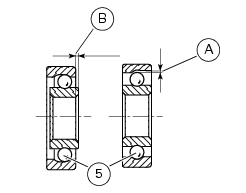
Check the amount of radial (A) and axial play (B). Excessive play will cause vibration and make the bike unstable. Change any badly worn bearings.
To remove the bearings (5) and the seals (4) from the wheel hub, follow the instructions below.
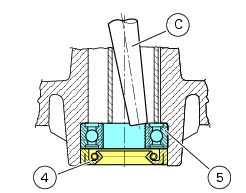
Position a drift (C) to the inner ring of the bearing (5).
Tap with a hammer until knocking out the bearing (5) and the seal (4).
Apply pressure at different positions to keep the bearing square during removal.
Caution
Never refit a bearing or seal you have removed.
Before you fit new bearings, check that the seat is clean and free from scoring and damage.
 
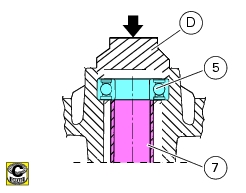
Grease the bearing seat and then push the bearing (5) into the seat.
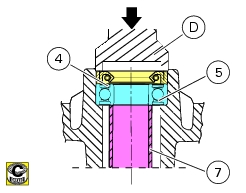
Using a tubular drift (D) which only exerts pressure on the bearing outer ring, drive the bearing fully into its seat.
Follow the same procedure to install the seals (4).
Ensure that the spacer (7) is in place between the two wheel hub bearings.
Note
Wheels must be rebalanced after repair, maintenance and overhaul operations.
Front wheel shaft
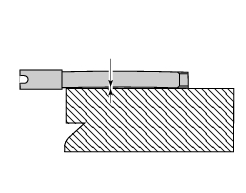
Check distortion of the wheel shaft.
Roll the shaft on a reference surface and measure maximum distortion using a feeler gauge (Sect. C 1.1, Front wheel).
Overhauling the front wheel rim
After you have checked the bearings, check the rims as follows.
Visually inspect the rim for cracks, scoring and deformation; change the rim if damaged.
Insert the wheel shaft in the wheel and mount the shaft on two fixed reference blocks.
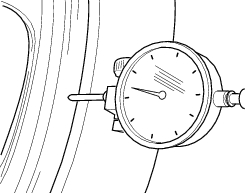
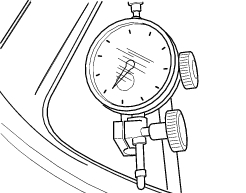
Using a dial gauge, measure rim runout and out-of-round relative to wheel shaft axis (Sect. C 1.1, Front wheel).
If the values measured are not within the limits, change the rim.
Refitting the front wheel
When through with the necessary inspections, refit the wheel as follows.
Lubricate spacers (3) and (9) and fit them in the seals on either side of the wheel hub.
Insert the complete wheel between the fork legs.
Grease the wheel shaft (10) and thread.
Fit the tool no. 8000.70139 to the wheel shaft (10).
Push the shaft (10) fully home into the wheel hub and insert the tool reference pin into the special notches at fork bottom end.
Grease the washer (2) to the wheel shaft end.
Grease the thread and underside of the shaft check nut (1) and then fit the check nut.
Tighten the nut (1) to the specified torque (Sect. C 3, Frame torque settings).
Refit the front brake calipers (Sect. G 3, Refitting the front brake system).
Check that the brake discs run smoothly inside the calipers.
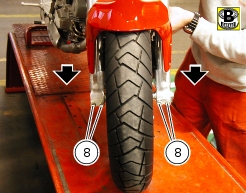
Before tightening the pinch bolts (8), lower the bike to the ground and press up and down on the handlebars to load the suspension so the fork legs will become properly seated onto the wheel shaft.
Lubricate the bolts (8).
Smear the screws (8) with recommended grease and tighten them to the specified torque (Sect. C 3, Frame torque settings) working in a 1-2-1 sequence.
1