2 -
1
2
3
4
5
6
7
8
9
10
11
12
13
14
15
16
17
18
19
20
21
22
23
24
25
26
27
Parts catalogue
Caution
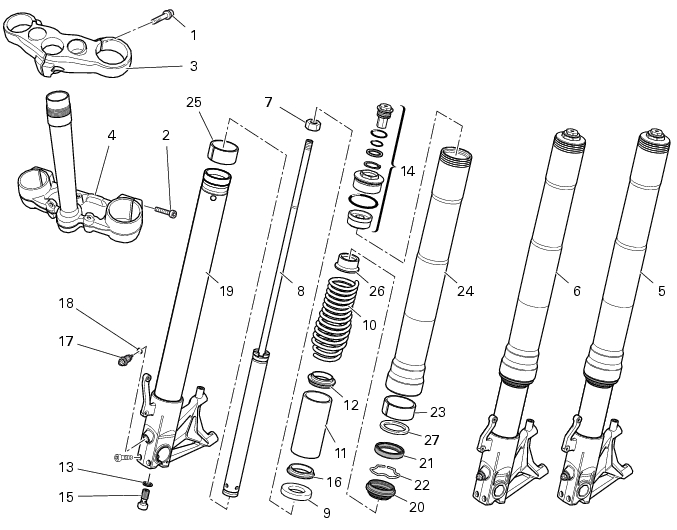
Bold reference numbers in this section identify parts shown in this exploded view diagram. These parts do not appear in the figures near the text.
Note
Not all shown parts are available as single spare parts but they are shown for a better understanding of the procedure.
Removing the front fork
Before the front fork can be removed, you will need to remove the components listed below:
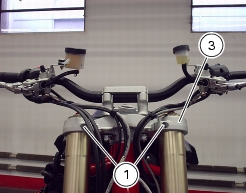
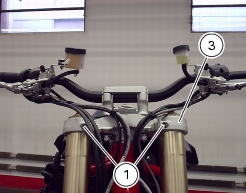
Loosen the pinch bolts (1) holding fork legs to steering head (3).
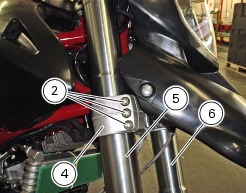
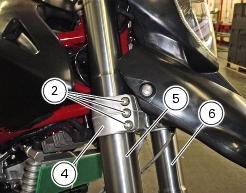
Loosen the pinch bolts (2) holding fork legs to bottom yoke (4).
Slide the fork legs (5) and (6) out downwards. Overhaul where necessary.
Overhauling the front fork
Note
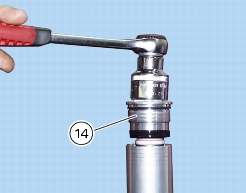
Loosen the plug (14) on the fork leg when still fitted onto the vehicle.
Note
The special tools required for front fork overhaul are listed in Section C 4, Frame special tools.
 
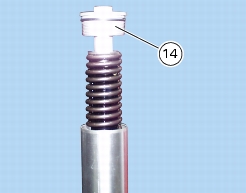
Loosen spring preload adjuster then loosen spring plug (14).
Loosen plug (14) together with rebound hydraulic adjuster.
Disassembling the front fork
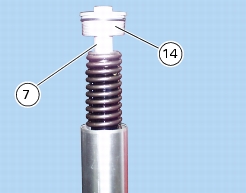
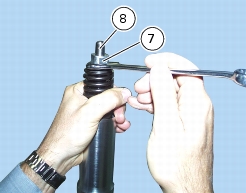
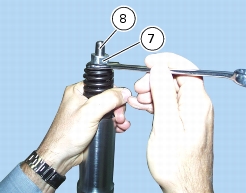
Secure check nut (7) using an hexagon wrench.
Using another hexagon wrench, undo plug (14) with seal, from cartridge (8).
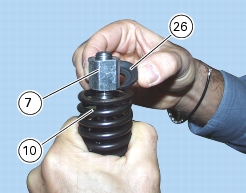
Loosen check nut (7) until cartridge (8) thread end.
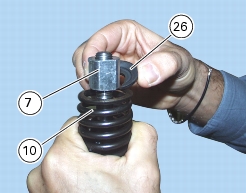
Keep spring (10) locked with your fingers, slide out bushing (26), and then slowly release spring (10).
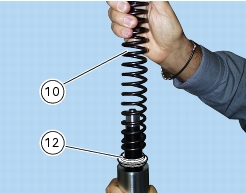
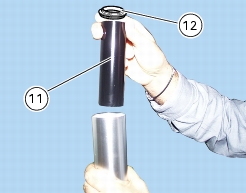
Slide out spring (10) and washer (12).
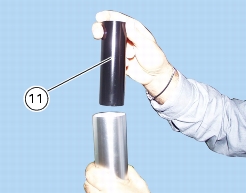
Remove preload tube (11), keep washer (16) and bushing (9).
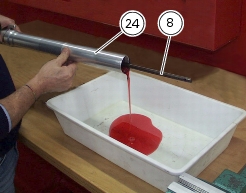
Pump the outer slider (24) and the damper cartridge (8) up and down to drain all oil.
Warning
When pumping, oil is pressurised.
Aim the fork at a container you will have prepared previously to avoid contact with fork oil.
 
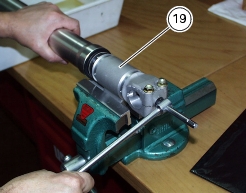
Clamp the slider (19) in a vice equipped with protection jaws.
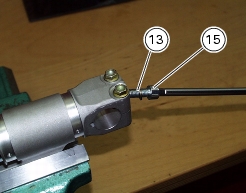
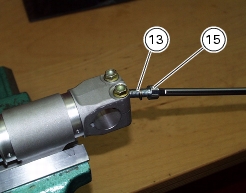
Loosen compression adjuster screw (15).
Remove the adjuster screw (15) and collect the seal (13).
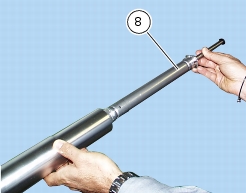
Remove complete damper cartridge (8).
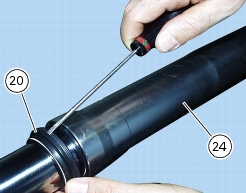
Remove the dust scraper (20) from the outer sleeve (24) with a screwdriver.
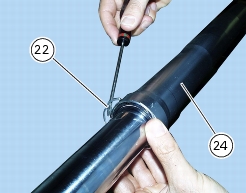
Remove the snap ring (22).
Caution
Take special care not to damage the slider (19) and circlip seat (22) inside outer sleeve (24).
 
Pull out the outer sleeve (24) from the slider (19). Quickly tap to counteract the pilot bush (23).
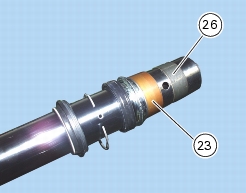
Remove the bush (25) from the slider by inserting a screwdriver into the bush opening.
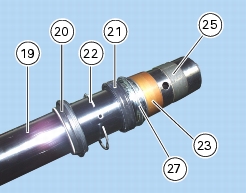
Remove from slider:
guide bush (23);
washer (27);
the oil seal (21)
snap ring (22);
dust seal (20).
Front fork inspection
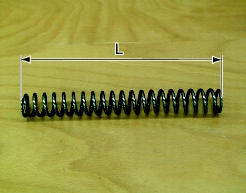
Place the spring on a flat surface and measure free length (L).
Service limit:
270 mm.
Change the spring if not within limit.
Check outer surface of both sliders and inner surface of both outer sleeves. They should show no signs of scores, scratches or distortions.
Check stanchion tubes straightness:
maximum allowed error: 0.10 mm.
It is good practice to change bushings (26) and (23) any time the slider is removed from the sleeve.
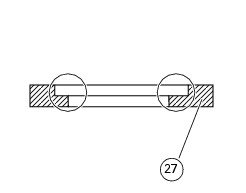
Check washer (27) distortion in the shown area. Change it, if distorted.
Reassembling the front fork
Clamp the slider in a vice.
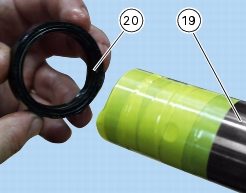
Tape the edge of the slider to protect it from damage.
Caution
Lubricate sliding surfaces with fork oil or seal grease before fitting the oil seal (21).
Install the oil seal (21) with the mark facing the dust seal (20).
 
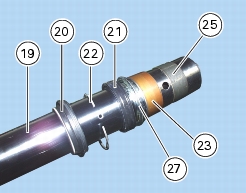
Fit the following parts into the slider (19):
-
-
-
-
-
-
Note
Before reassembling the slider with the outer sleeve, lubricate the bushing sliding surfaces with fork oil.
 
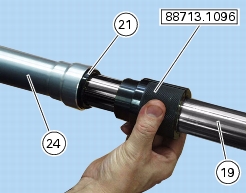
Seat the pilot bush (23) and the ring (27) into the outer sleeve (24) with the special tool (F, part no. 88713.1096).
Seat the seal ring (21) into the outer sleeve using the same tool.
Fit the snap ring (22) and the dust seal (20).
 
Caution
The outer sleeve must slide freely along the slider. Only support the sliders and the outer sleeve with your hands so not to damage the oil seals and the pilot bushes.
 
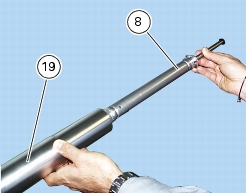
Fit the complete damper cartridge (8) into the slider (19).
Fit seal (13) and tighten compression adjustment screw (15) to the specified torque (Sect. C 3, Frame torque settings).
Fill each leg with half the recommended oil quantity (Sect. C 2, Fuels and lubricants).
Pump up and down to fill whole inner volume.
Take both damper cartridge and outer sleeve to the end of their stroke.
Fill the fork leg with the remaining amount of oil and measure oil level.
Caution
Keep fork leg vertical when measuring oil level. Make sure oil level is the same in both fork legs.
 
Recommended oil:
SHELL Advance Fork 7.5 or DONAX TA
Standard capacity:
0.480 cu.dm per leg.
Standard oil level:
104 mm.
 
Oil quantity affects fork behaviour when at the end of the compression stroke.
High oil level increases compression loading, low oil level will lessen it.
Remove oil from the spring (10) and the lock nut (7).
 
Fit the following parts:
bushing (9), washer (16) and preload tube (11).
Install spring (10), washer (12), bushing (26) and check nut (7), with the tapered side facing check nut (23) and washer (8).
Screw check nut (7) onto cartridge (8) using a hexagon wrench.
Using the same wrench, hold check nut and screw top plug (14) with O-ring onto cartridge (8).
Tighten top plug (14) to the specified torque (Sect. C 3, Frame torque settings).
Refitting the front fork
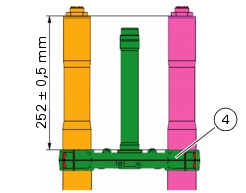
Refit the fork legs. Fork leg height above bottom yoke top face is reported in the figure.
Warning
The difference in height between the two legs must not exceed 0.1 mm.
 
Position the fork legs (5) and (6) onto the bottom yoke (4).
Position the fork legs (5) and (6) onto the steering head (3).
Tighten the screws (2) and (1) to the specified torque (Sect. C 3, Frame torque settings) to fasten the legs to the bottom yoke (4) and the steering head (3).
Caution
If the pinch bolts (1) and (2) were removed on disassembly, smear the threads with the specified grease before tightening.
Refit any components you have removed from the frame:
Warning
Do not ride with the front mudguard removed. The brake hoses are retained to the front mudguard to keep them from touching the wheel under braking.